Issued 4 Oct 2026
Accounts payable
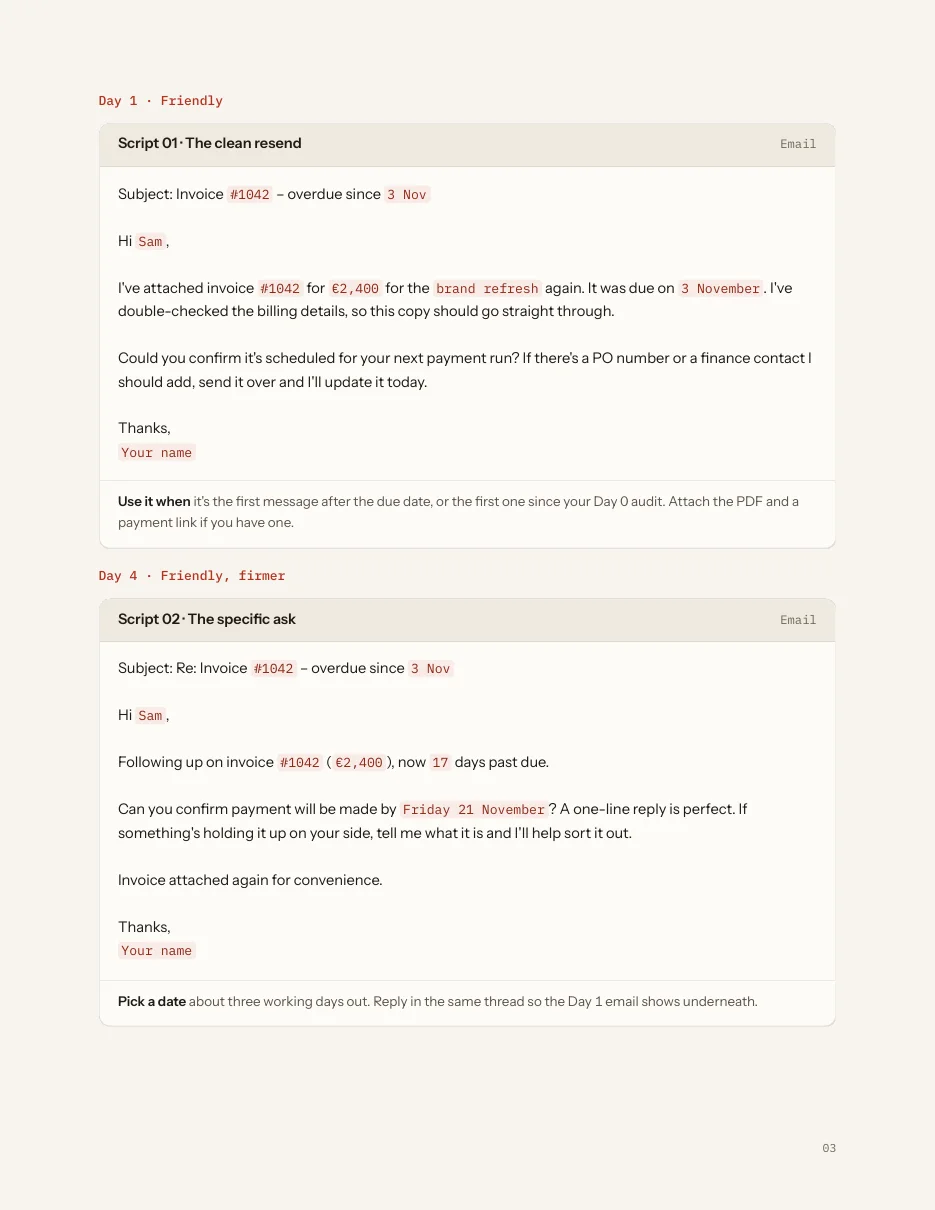
- D+01Clean resend, finance copied17 Nov
- D+04“Can you confirm by Friday?”20 Nov
- D+07Call: “Paid Thursday. Priya has it.”23 Nov
- Paid€2,400.00 received
Terms: 30 days from issue · Bank transfer or card
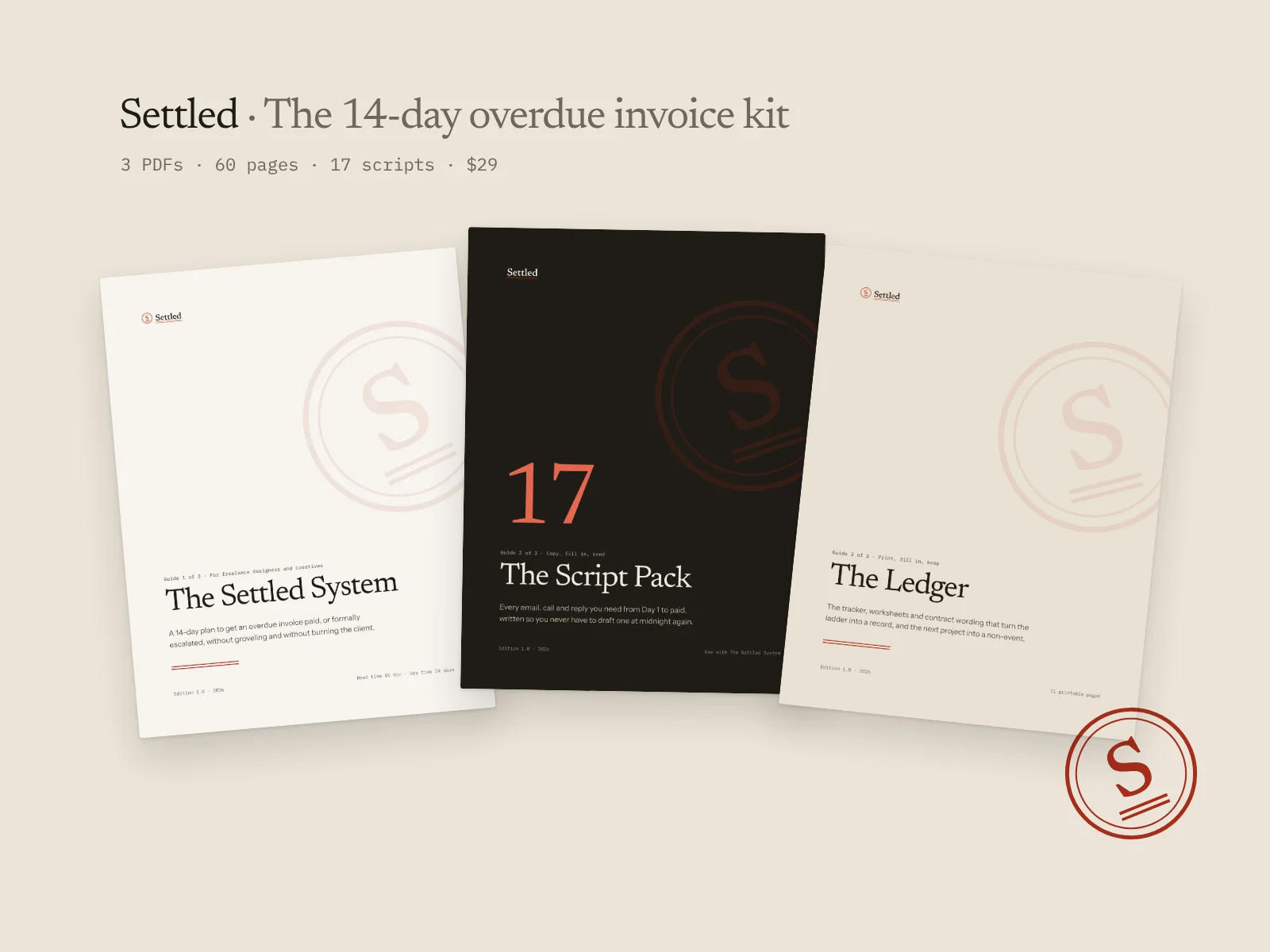
Six dated steps and 17 ready-to-send scripts. You start with a polite resend on Day 1 and finish with a formal final notice on Day 14, so the invoice gets paid or moves to a claim, and you keep the client.
Terms: 30 days from issue · Bank transfer or card
“Just checking in.” Then “Sorry to bother you again.” Then a third draft at midnight, so it doesn't sound pushy.
The work was approved weeks ago. The invoice was due on the 3rd. You've nudged once, then more softly, and now you're wondering if asking for your own money will cost you the client.
Here's what's usually going on. The invoice isn't being refused. It's stuck in a finance queue you've never seen: wrong company name, no PO number, no real due date, a missed payment run. Every polite follow-up tells that queue it can wait.
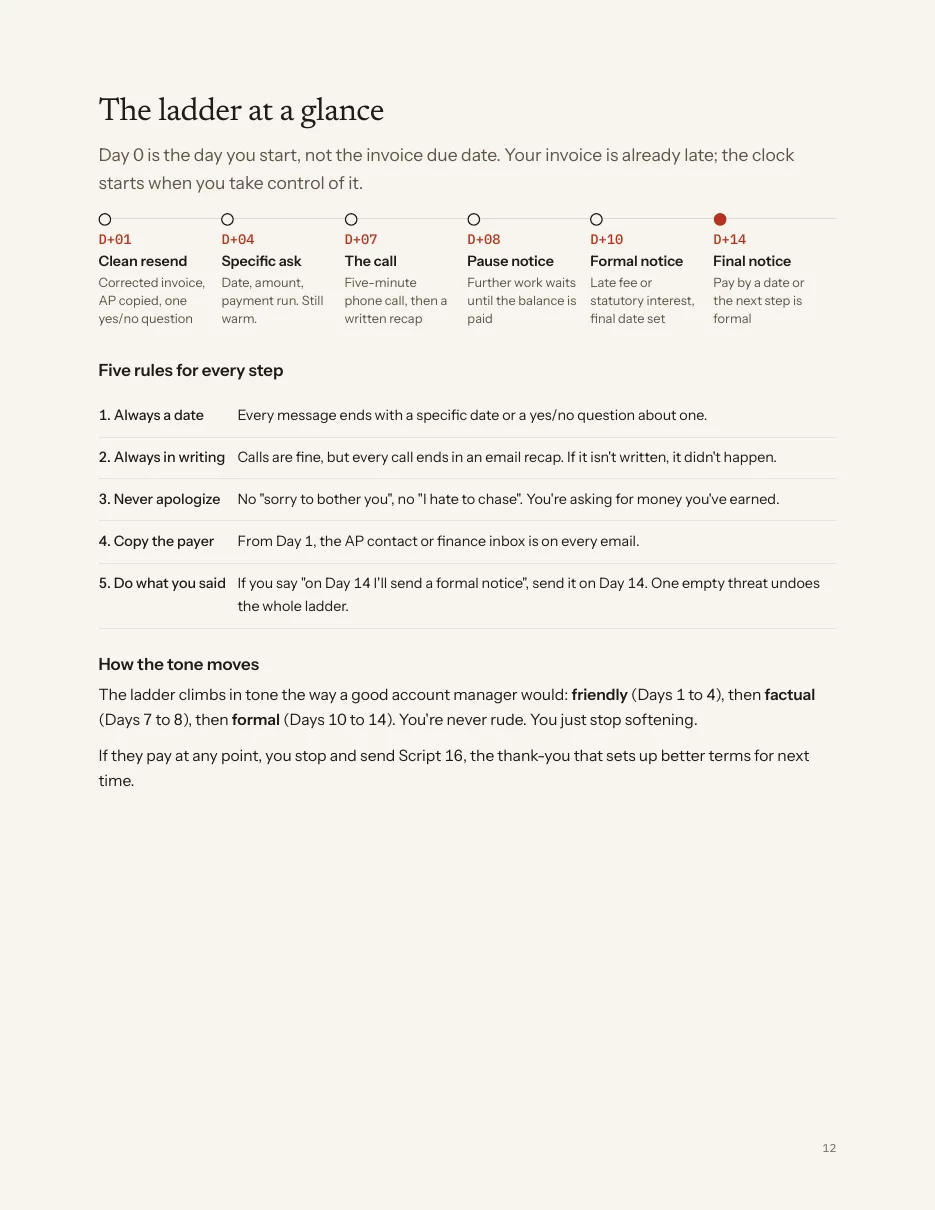
Settled replaces the guessing with six steps on six dates. Each message has a date in it and copies the person who actually pays. Each one is a little firmer than the last. In 14 days the invoice is paid, or it's on a formal footing you can act on.
The ladder
Corrected invoice, finance copied, one yes-or-no question about the next payment run.
Friendly“Can you confirm payment by Friday the 21st?” Your date, not theirs.
FriendlyFive minutes on the phone. Get a date and a name, then recap it in writing.
FactualFurther work waits until the balance is paid. Deadlines move by the same days.
FactualAdd the late charges you're entitled to under your contract or the law.
FormalPay by a date, or the next step is a claim or an agency. You choose which.
FormalA vague question gets a vague answer. A date gets a yes or a no.
From Day 1, finance sees every email, so the invoice sits in the right queue.
The tone climbs from friendly to formal. It never turns rude, and it never pleads.
Why 14 days
At 30 days late you're still in a strong position. Somewhere between one and three months, the odds drop. The ladder gets you to a decision while the invoice is still young.
Probability of recovering a commercial debt by age. Commercial Law League of America. Agency-reported figures, best read as a direction rather than a promise.
What's inside

Why invoices stall, the 20-minute Day 0 audit, the full ladder, your four options after Day 14, and your rights in the UK, EU and New York.
Every email, the phone call and voicemail, the final notice letter, and replies to “it's with finance” and “we weren't happy with the work”.
Printable tracker, ladder log, interest calculator, write-off maths, client risk score and a clause bank for your next contract.


Before you ask
The tone climbs slowly and never turns rude. Script 16 resets terms warmly once you're paid. Good clients respect a clear process; the ones who don't were never going to pay on time.
Each step is one script with the blanks marked. Fill them in and send: about five minutes, six times over two weeks.
Reminders ask a question that doesn't need an answer. The ladder asks for dates, copies the payer and escalates on schedule. Start at Day 1 even if you've nudged before.
The method works anywhere. The rights section covers UK and EU late payment law and New York's Freelance Isn't Free Act, and shows you how to check your own country's rules.
The write-off maths tells you whether chasing is worth your hours. Most of the time the first three steps cost almost nothing.
Script 12 separates fixing real issues from the fee for work they approved and are using, and Day 0 gets your proof folder ready before you need it.
Where the method comes from
Settled doesn't rely on testimonials or a guru story. It's built from published data on how debts age, the late payment laws freelancers can actually use, and how accounts payable teams process invoices. Every figure in the guide is cited, so you can check it.
The kit
$29 is about 1% of a typical €2,400 design invoice. If the ladder moves one stuck payment, it has paid for itself, and the prevention setup in Part 07 is built so the next invoice never needs the ladder at all.
Invoices to private individuals rather than businesses, or large disputes about the quality of the work. For those, talk to a local adviser or lawyer. Settled is practical education, not legal advice.
30-day refund. Use the ladder for 14 days. If it didn't help you get paid or move the invoice to a formal next step, email us within 30 days of buying for a full refund. No form, no questions.
Questions
No. It's practical education. Where the guide mentions a law, it tells you what to check in the official text before you rely on it. For large amounts or real disputes, speak to a local adviser.
The ladder works the same anywhere, because it's about process and clarity. Formal routes after Day 14 differ by country, and the guide explains how to find the right one.
Use the platform's own dispute or payment protection process first; it often has strict deadlines. The Day 0 audit reminds you to check them before you start.
Yes. The examples use design projects, but every script works for any freelance service billed to a business.
Three PDFs. The scripts are plain text inside them, ready to copy into your email. The Ledger is designed to print, or to copy into a spreadsheet.
No one can, and anyone who promises it is guessing. What the ladder guarantees is that in 14 days you'll either be paid, have a written commitment, or be ready to act formally, with a full record of every step.